Official Louisiana State Websites use .la.gov
  Secure .gov websites use HTTPS
Disaster Debris Management
Louisiana Revised Statute 30:2413.1 focuses on how the state should prepare for and manage debris after natural disasters, especially hurricanes. The legislation was created due to the devasation from natural disasters, like Hurricanes Katrina and Rita, which generated unanticipated amounts of debris.
This legislation declares that a comprehensive debris management plan for future natural disasters is vital to the protection and welfare of the people of the state of Louisiana.
The Louisiana Department of Environmental Quality (LDEQ) developed a comprehensive plan to manage debris generated by natural disasters. This plan shall reuse, and recycle materials and divert debris from disposal in landfills to the extent possible and in a manner that is protective of human health and the environment.
This plan shall explain how debris will be collected, sorted, recycled, and safely disposed of. It also encourages coordination between state agencies, local governments, and emergency responders so everyone is aware of their responsibilities. The plan is designed to provide guidance to local governments and state agencies in determining appropriate debris management sites for temporary activities that may be required to respond to a natural disaster.
The purpose of the legislation and the development of a comprehensive debris management plan is to promote efficient, practical, timely, and safer disaster cleanup. By planning ahead, Louisiana can protect public health, reduce environmental damage, and help communities recover more efficiently after natural disasters. Overall, the legislation emphasizes preparedness, safety, and teamwork in managing natural disaster debris.
Emergency Debris Site Activation:
Phone: (225) 364-7901Emergency Debris Site Forms
Email: deqdebrisrequest@la.gov
Fax: 225-325-8236Emergency Debris Site Questions
Email: deqdebrisrequest@la.gov
Phone: 225-364-7901Written requests should be mailed to:
Office of Environmental Services
Post Office Box 4313
Baton Rouge, Louisiana 70821-4313
Emergency Debris Sites
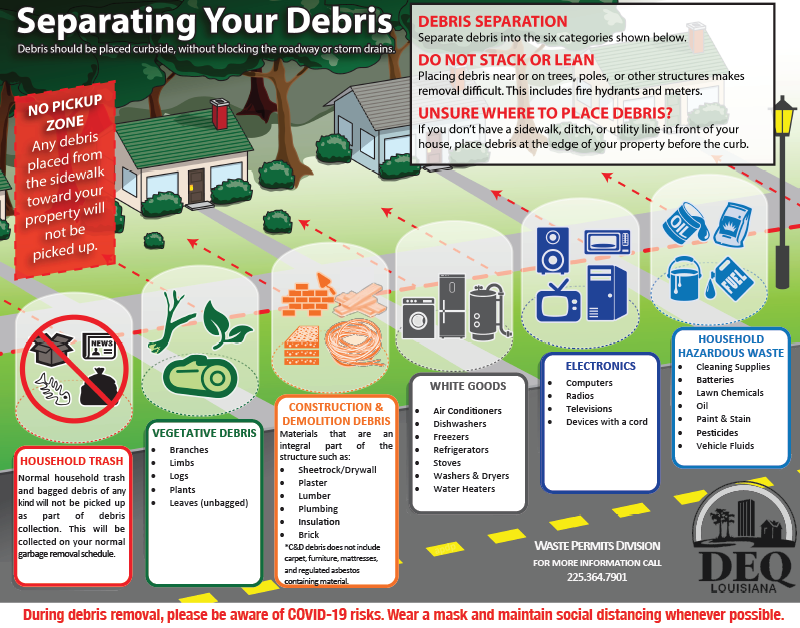
Emergency debris sites are locations that are identified by the local governments or state agencies and evaluated and approved by the LDEQ for the purposes of managing disaster generated debris.
These sites are carefully selected to protect human health and the environment.
Overall, emergency debris sites assist local governments in recovery after a natural disaster and the handling, processing, recycling and disposing of disaster related debris.
Approved Emergency Debris Sites
Emergency Debris Site Application
- Emergency Debris Site (EDS) Request and SHPO Form (04/28/2023)
Note: Include most recent SHPO approved form with your EDS form for all existing pre-approved sites (a copy may be obtained from SHPO or from LDEQ EDMS).
Comprehensive Plan for Disaster Clean-up and Debris Management
- Comprehensive Plan for Disaster Clean-up and Debris Management (9/14/2024)
- Appendix A & Appendix B of the Administrative Order and Authorization for Pre-approved Emergency Debris Sites (6/12/2024)
Emergency Debris Site Forms
Emergency Debris Site Activation, Operation and Deactivation
Upon the declaration of an emergency by LDEQ, local governments and state agencies may "activate" a pre-approved emergency debris site by doing the following:
- The governmental body shall notify LDEQ Headquarters at (225) 364-7901 that the site is being activated. This verbal notification shall occur as soon as practicable depending on communication capability. If LDEQ Headquarters does not have communication capability, please call your local LDEQ Regional Office.
- Submit the Written Notification of Activation within five (5) days.
- Once the emergency debris site has been activated submit Weekly Debris Management Reports (WDMRs) for vegetative debris and construction and demolition debris (C&D).
Once the emergency declaration has ended or the site has completed all debris activities, the site shall be deactivated by:
- Contacting your regional office for a deactivation site inspection. You will need to submit a Written Request for Deactivation.
- Once headquarters receives the deactivation inspection report from the regional office and all WDMRs, a deactivation letter will be sent. The site will be required to reactivate should another emergency occur.
Permit Variances during Emergency Events
During a declared emergency, Louisiana can issue an Emergency Declaration and Administrative Order, also called a DEAO. This order gives the Louisiana Department of Environmental Quality permission to temporarily relax certain rules for facilities that already have environmental permits. These temporary changes, called variances, allow facilities to keep operating safely during the emergency without going through the usual long process of modifying their permits.
However, if a facility’s emergency activities cause long‑term changes or if the facility wants to continue those activities after the emergency ends, it must request a formal permit modification. This request has to be submitted within six months after the Governor declares the emergency, unless the Department gives more time. The goal is to help facilities respond quickly during emergencies while still protecting the environment in the long run.
For variances, waivers, letters of response, or for other questions, please contact the following individuals in the Office of Environmental Services:
- Air - Bryan Johnston
Phone: (225) 219-3001
Email: bryan.johnston@la.gov- Water - Jenniffer Sheppard
Phone: (225) 219-3197
Email: Jenniffer.Sheppard@LA.GOV- Waste - Robert Thomas
Phone: (225) 219-3604)
Email: Robert.Thomas@la.gov- Asbestos - Charles Finley
Phone: (225) 219-3241
Email: Charles.Finley@la.govWritten variance requests should be submitted to one of the following addresses:
U.S. Mail Address:
Office of Environmental Services
P.O. Box 4313
Baton Rouge, Louisiana 70821-4313
Service Carrier/Hand-Delivery Address:
Office of Environmental Services
602 N. 5th St.
Baton Rouge, LA 70802
Other Helpful Links
- LDEQ Hurricane Information Page with Parish Resource Book
- Debris-related Fact Sheets and Policies from FEMA
To get potential applicants on the right track with their contracts, monitoring, etc., refer to: - EPA Publication "Planning for Natural Disaster Debris"
- Concrete Slab, Concrete Recycling, and Reuse
- Concerns in Using Vegetative Debris in Coastal Restoration Projects