 Official Louisiana State Websites use .la.gov
  Secure .gov websites use HTTPS
Human Health: Fish Consumption, Swimming, and Sediment Advisories
Advisory Map
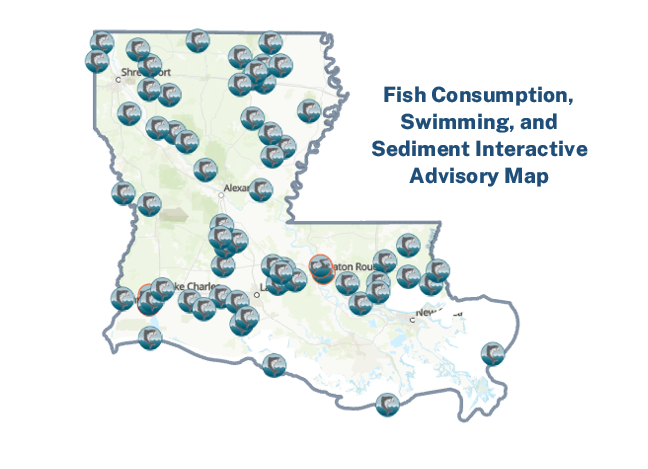
Interactive Fish Consumption and Swimming Advisories Map
- Click any fish icon to view information such as advisory type, meal recommendations, and issue date for each area highlighted in orange.
- If fishing along or near an advisory boundary, but not within the highlighted area, it is recommended to follow the nearest advisory's meal limits.
- As you zoom into the map a water body layer will appear showing the larger streams and lakes.
- The legend panel expands using the toggle button (top left corner).
- Use the search tool, (top right corner) to quickly locate an area of interest (e.g., a specific lake or river).
- Note: One meal is considered to be one half pound of fish.
The state of Louisiana has issued health advisories for certain waterways where harmful substances may affect people who catch and eat their own fish and shellfish, swim, or come into contact with the sediment. Mercury is the primary pollutant for which health advisories are issued.
The Louisiana Department of Health (LDH) Health/Fish Consumption Advisories Program, together with with the Louisiana Departments of Environmental Quality and Wildlife and Fisheries, issue advisories to help ensure the safe enjoyment of Louisiana's water resources. When needed, the Louisiana Department of Agriculture and Forestry is also consulted when developing and sharing the advisories. An Interagency Agreement between the four agencies was agreed upon February 2012.
Louisiana’s fish consumption advisories are based on a public‑health risk assessment that determines how much fish/shellfish people can safely eat to avoid harmful health effects. This method helps set safe eating guidelines for different groups of people.
- For example, children and women who are pregnant or could become pregnant are evaluated separately because they face higher risks from contaminated seafood. As a result, those advisories are usually more strict.
The document, "Protocol for Issuing Public Health Advisories for Chemical Contaminants in Recreationally Caught Fish and Shellfish," presents details about how advisories are developed. Currently, LDEQ is the main agency responsible for collecting and reporting mercury levels in fish tissue used to develop advisories. Sampling is done in different areas across the state. Other information and samples may also be reviewed during the advisory process.
When new or updated advisories are approved by all parties, LDH provides a news release to the public and notifies parish leaders. Newspapers and other messaging outlets are also contacted and provided information. LDWF and LDEQ may amplify the advisory news release, and LDWF publishes advisory information with fishing regulations (websites are always the most up-to-date).
Additionally, to help people understand the health risks and recommended limits for eating fish/shellfish, LDEQ places advisory signs around the lakes, rivers, and other waterways that are affected.
- For fish consumption advisories, signage is directed at public launches and fishing piers; other high use areas may also be targeted.
- Swimming and sediment contact advisories signs are distributed around the water body. These signs outline the advisory and if needed, what seafood should be avoided or restricted.
*Once advisories are made public, staff begins to install the signs. This may take several weeks to complete; please use the interactive map or call if uncertain of advisory status*
Please contact the LDEQ at 1-866-896-5337 or by e-mail to Water Planning and Assessment Division with any questions or concerns about signage.
Working together, LDH and partners created a brochure that explains how to choose, clean, and cook fish and shellfish caught by the general public in our state. The brochure, called Eating Recreationally Caught Seafood in Louisiana, gives tips to help people reduce their exposure to harmful substances that may be present.
National recommendations on eating fish and shellfish have been developed by the US Environmental Protection Agency and the Food and Drug Administration. These guidelines help people weigh the benefits and potential risks of eating seafood, including those from commercial sources.
Louisiana created the Mercury Initiative in 2006 to help reduce mercury in the environment. You can find information, explanations, and further guidance about mercury on the LDEQ Mercury Initiative website.
- Fish Consumption and/or Swimming Advisories Due to Mercury or Organic Chemical Contamination
- Advisories updated 9/24/2026
LDEQ developed smart phone applications in 2019 for mobile map viewing of the advisories; changes in the industry have required programing changes to the android version, which is currently unavailable. Both iOS and android applications are undergoing updates, and will be made available as soon as possible. The existing iOS cell phone version may be found here: Smart Phone Advisory app. Please check back to the website periodically for more information.
For more information regarding mercury and other fish consumption advisories contact the LDH hotline at 1-888-293-7020 or call LDEQ Customer Service at 1-866-896-5337.
Website updated 09/23/2026