 Official Louisiana State Websites use .la.gov
  Secure .gov websites use HTTPS
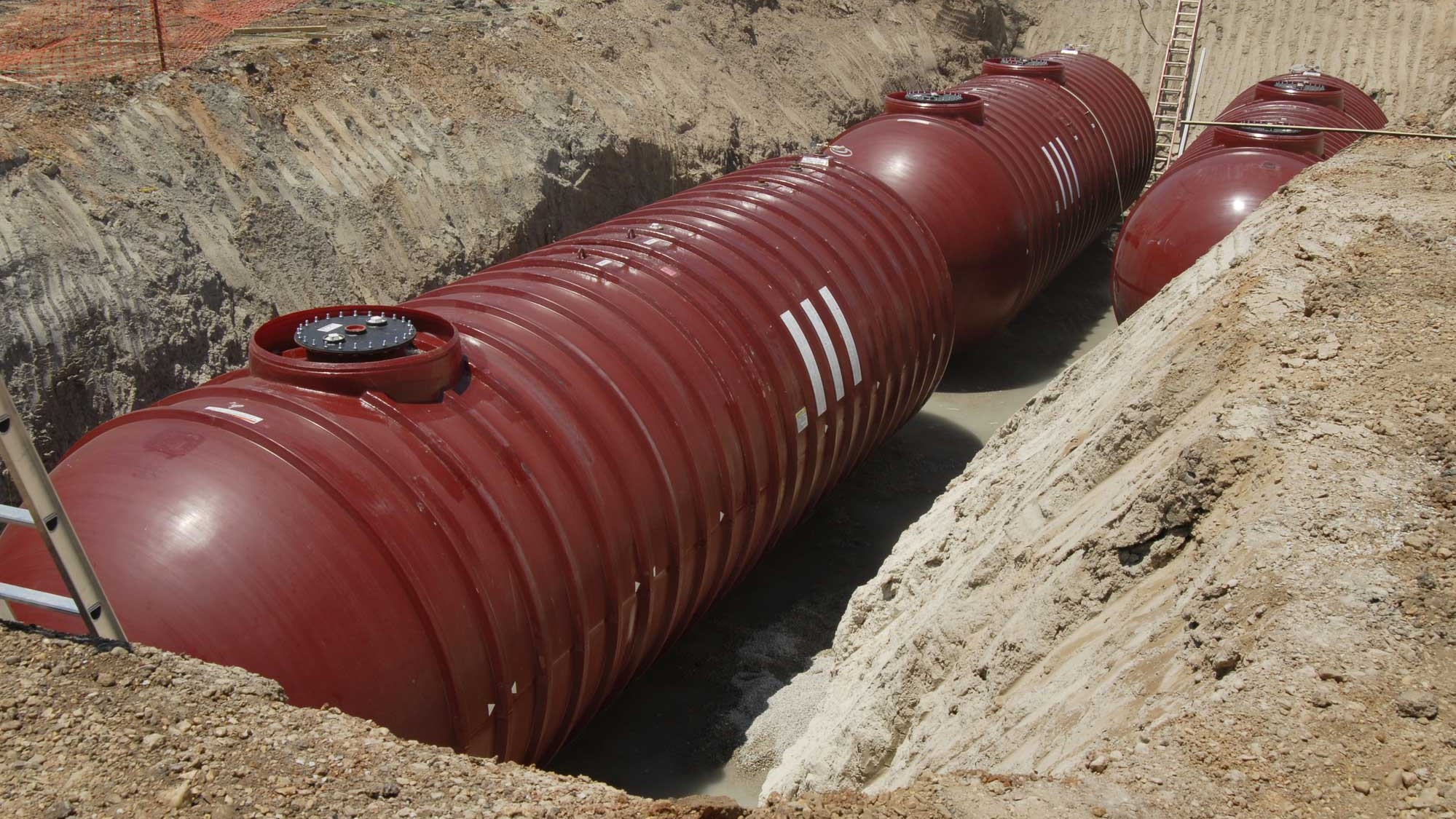
Underground Storage Tank (UST) Compliance
In addition to the Underground Storage Tank Regulations Title 33 Part XI, on August 8, 2005, the Energy Policy Act of 2005 was signed into law. Among other things, this law makes amendments to Subtitle I of the Solid Waste Disposal Act. The Solid Waste Disposal Act was the federal legislation that originally created the Underground Storage Tank (UST) program in 1986. The portion of the Energy Act that contains the amendments to this program is found in Title XV, Subtitle B, a portion entitled the Underground Storage Tank Compliance Act of 2005. The legislation is aimed at reducing the number of underground storage tank releases to the environment by focusing on preventing releases. In order to successfully implement the changes prescribed by this legislation, EPA and the state will work closely with tank owners, operators, as well as other stakeholders targeting the following:
- UST Inspections
- Operator Training
- Secondary Containment or financial Responsibility/Installer Certification
- Delivery Prohibition
- Public Record
- State Compliance Reports on Government Owned/Operated Underground Storage Tanks
For additional information regarding Louisiana's actions to meet the standards set by the Energy Act including answers to when and how the changes will be implemented, refer to the Summary of the Federal Provisions and Deadlines.
Submittal Contact Information
Southeast Regional Office
990 N. Corporate Drive, Suite 102New Orleans, LA 70123
_DEQ-USTCompliance-SERO@la.gov
Kisatchie Central Regional Office
2800 S. MacArthur Drive, Suite AAlexandria, LA 71301
_DEQ-USTCompliance-NERO@la.gov
Northeast Regional Office
508 Downing Pines RoadWest Monroe, LA 71292
_DEQ-USTCompliance-NERO@la.gov
Northwest Regional Office
1525 Fairfield Avenue, Room 520Shreveport, LA 71101
_DEQ-USTCompliance-NWRO@la.gov
UST Compliance Program
Overview
1523 of the Energy Policy Act amends the inspection provisions in Section 9005 of the Solid Waste Disposal Act (SWDA). More specifically, it adds additional requirements for underground storage tank (UST) system compliance inspections for states receiving Subtitle I funding. On April 24, 2007, EPA issued the final grant guidelines for these compliance inspections. (View the grant guidelines) The guidelines identify which underground storage tanks were to be inspected, the requirements for the on-site inspections, who is authorized to perform the on-site inspections, and the reporting requirements to EPA. The deadline for the completion of the inspections is August 8, 2007, and following the completion of this round of inspections, each underground storage tank shall be re-inspected for compliance at least once every three years.
Local Response
LDEQ worked closely with LDEQ Contractors and EPA Inspectors in order to meet the initial requirement set forth by this section of the UST Compliance Act – inspecting all un-inspected UST facilities prior to August 8, 2007. In 2007, LDEQ performed 457 inspections, LDEQ Contractors performed 314 inspections, and EPA Contractors performed 913 inspections. The result of this collaborative effort was that Louisiana met the initial requirement of this section of the UST Compliance Act on August 7, 2007, and began planning for the next phase of this section- the three year inspection cycle. As of December 2021, LDEQ has completed four 3-year inspection cycles and is currently in the middle of the fifth 3-year inspection cycle.
Overview
This section requires the development of training guidelines for those who operate and maintain federally-regulated underground storage tank systems (Section 1524 of the Energy Policy Act of 2005). EPA, the states, and other states worked closely together to develop the operator training grant guidelines. These guidelines define three distinct classes of UST operators, describe the how and when the guidelines will be implemented within the states, and provide operator training deadlines.
- Louisiana UST Operator Training Seminar registration
- UST Operator Training Program Fact Sheet
- UST Operator Training Final Regualtions in LAC 33:XI. Chapter 6 - click here
- Operator Training FAQs
Overview
The Energy Policy Act of 2005 mandated states to require either evidence of financial responsibility and installer certification or secondary containment and under-dispenser containment for new and replaced underground storage tank systems.
In order to meet these federal requirements and develop regulations, the Louisiana Department of Environmental Quality (LDEQ) formed a work group consisting of LDEQ staff, owners, operators and installers of UST systems and representatives of LOMCSA. After extensive research and discussions with stakeholders, LDEQ proposed Secondary Containment for UST Systems regulations (UT014) on June 20, 2008. The public comment period ended and the rule became final on October 20, 2008.
This new rule requires all UST systems installed after December 20, 2008 to have secondary containment (double-walled or jacketed tanks and piping) with monthly interstitial monitoring provided on both the tanks and the piping. Interstitial monitoring of double-walled or jacketed tanks and piping can be conducted either continuously by means of an automatic leak sensing device that signals to the operator the presence of any regulated substance in the interstitial space, or manually every 30 days by means of a procedure capable of detecting the presence of any regulated substance in the interstitial space.
If a single-walled underground storage tank was placed in the ground at the location where was to be put into service prior to December 20, 2008 the UST owner was allowed 90 days (until March 20, 2009) to complete the UST system installation without having to comply with the secondary containment requirements.
If 25% or more of a piping run to any one UST is repaired or replaced, the entire piping run must be secondarily contained with monthly interstitial monitoring.
UST systems installed after December 20, 2008 are also required to have under-dispenser containment and submersible pump containment.
After December 20, 2008 under-dispenser secondary containment (UDC) sumps are required under the following conditions:
- in any installation of a new dispenser at a new facility;
- in any installation of a new dispenser at an existing facility where new piping is added to the UST system to connect the new dispenser to the existing system; and
- in any installation of a replacement dispenser at an existing facility where the piping that connects the dispenser to the existing piping is replaced, including replacing the metal flexible connector, riser, or other transitional components that are beneath the dispenser and the impact shear valve and that connect the dispenser to the piping. Replacing an existing dispenser where no piping and none of the piping that connects the dispenser to the existing piping are replaced does not require the addition of an under-dispenser containment sump.
After December 20, 2008 secondary containment for submersible pumps is required under the following conditions:
- in any installation of a new STP at a new facility;
- in any installation of an STP (the entire STP, STP housing, and riser pipe) at an existing facility where new piping is added to the UST system to connect the new STP to the existing system; and
- in any installation of a replacement STP (the entire STP, STP housing, and riser pipe) at an existing facility where the piping that connects the STP to the existing piping is replaced. Replacing the metal flexible connector with a single-walled flexible connector requires the addition of a containment sump. Replacing the metal flexible connector with a double-walled flexible connector does not require the addition of a containment sump as long as the newly-installed STP is secondarily contained. Replacing an existing STP where no piping is replaced does not require the addition of STP secondary containment.
UDC and STP containment sumps installed after December 20, 2008 must be liquid-tight on sides, bottoms, and at penetrations, and be maintained free of storm water, debris, and regulated substances. Regulated substances spilled into any UDC or STP sump shall be immediately removed upon discovery to the maximum extent practicable.
After October 20, 2008 all spill buckets must have liquid-tight sides and bottoms and be maintained free of regulated substances. Regulated substances spilled into any spill bucket must be immediately removed.
These actions were taken to maintain federal funding and delegation of the UST program in the State of Louisiana. This will further enhance our effort to maintain protection of human health and the environment by allowing new UST systems to contain and detect product leaks before they enter the environment. The UST regulations (LAC 33:XI – Underground Storage Tanks) can be reviewed on our website.
The UST Division gave presentations on the new secondary containment regulations to certified UST installer and repair contractors in March 2010. A copy of the presentation is available on the LDEQ ENVIROSCHOOL Library page: https://www.deq.louisiana.gov/assets/docs/About_LDEQ/enviroschool/ENVIROSCHOOL-Secondary-Containment-March2010.pdf.
If you have any questions or need further clarification of these new regulations, please feel free to call Samuel Broussard of LDEQ’s UST Division, at samuel.broussard@la.gov or 337-262-5744.
A consortium of representatives from U.S. Environmental Protection Agency (EPA), states, underground storage tank owners, and the product delivery industry developed the guidelines to implement the delivery prohibition provision in Section 9012 of the Solid Waste Disposal Act (SWDA), enacted by the Underground Storage Tank Compliance Act. The guidelines, issued August 7, 2006, established the minimum requirements a state’s delivery prohibition program must meet in order to comply with the delivery prohibition provision of the Energy Policy Act of 2005.
Following the issuance of these guidelines, LDEQ worked diligently to meet the implementation deadline of August 8, 2007. A collaborative effort from a work group made up of LDEQ and industry representatives resulted in the development of regulations which were adopted as Louisiana rule on September 20, 2007.
The rule establishes standards for the red tag/delivery prohibition of regulated substances for underground storage tanks. The rule defines the responsibilities of the tank owners/operators and product deliverers to ensure that product is not delivered, deposited, or accepted into an ineligible UST system. Furthermore, it defines those UST systems that are affected and the requirements that the owner/operator of the UST system must meet in order to continue to receive delivery of fuel, as well as situations when the department may prohibit the delivery of fuel. These regulations prohibit the delivery of regulated substances for UST systems that are discovered not to meet the required 1998 standards or are not compliant with spill prevention, overfill protection, release detection, corrosion protection, financial responsibility, or registration requirements in accordance with LAC 33:XI. Click here for more information regarding these regulations: LAC 33:XI.Chapter4.Sections 401 and 403
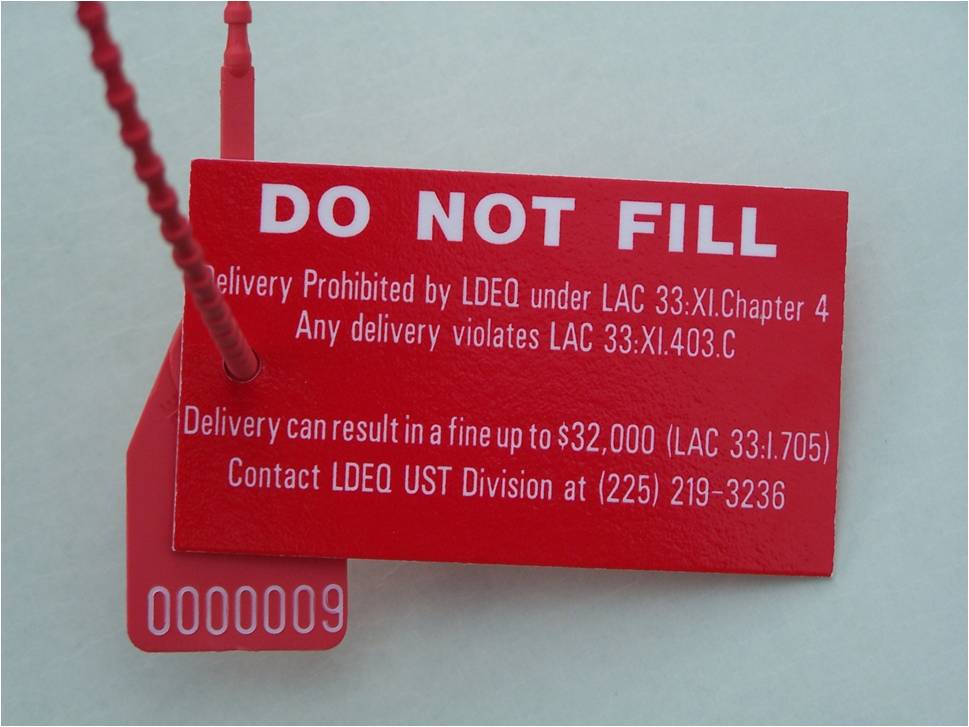
On March 14, 2008, LDEQ issued a Notice to all UST Owners and Fuel Distributors regarding Red Tagging of Fill Ports/ New UST Delivery Prohibition Process. This notice was sent to inform those persons that beginning April 15, 2008, the LDEQ UST Division will begin implementation of these Delivery Prohibition regulations. At this time certain USTs will be classified by the department as ineligible for delivery, deposit, or acceptance of product by means of "Red Tagging." At this time LDEQ will immediately "Red Tag" any tank/tank system that:
- is not registered
- do not meet the 1998 upgrade requirements (no corrosion protection, no spill prevention, or no overfill protection)
- no established release detection method
- has released product, but the release has not been addressed
LDEQ will also "Red Tag" tanks/tank systems with other violations such as: no financial responsibility or deficiencies in the operation and maintenance of release detection, corrosion protection, or spill and overfill protection. For these violations, the facility must correct the deficiency/deficiencies within 30 days of being notified by LDEQ. If after that time the deficiency/deficiencies are not corrected, physical red tags will be tied around the affected tank fill ports. The facility will be allowed to sell the remaining fuel in the affected tank(s), but it will be unlawful to deliver fuel into the affected tank(s) until the tank/tank system has returned into compliance with the regulations (LAC 33:XI.403C).
If it is discovered that any fuel is delivered into a UST that has been "Red Tagged," LDEQ may take enforcement action against both the UST owner and the fuel distributor. These violations can result in penalties up to $32,500 per event. In order to provide adequate notice to product deliverers, LDEQ will publish a list of "Red Tagged" facilities on this website. This list will be updated whenever facilities are added and removed from the list. The red tagged facility list can be found at: UST Red Tagged Facilities
This section manages the records of underground storage tanks that are regulated under Subtitle I (Section 1526 of the Energy Policy Act). This amendment requires states to provide the public information on the percentage of tank compliance; the numbers of underground storage tanks, facilities, and inspections; information on confirmed releases; as well as sources and causes of releases. These records must be to be maintained, updated, and made available to the public by the state. These guidelines describe the minimum requirements that a state's public record program must adhere to in order to comply with the statutory requirements. The guidelines include:
- Developing and maintaining the public record
- Making the public record available to the public
- Content required for the public record
- Ensuring data quality
- Means to demonstrate compliance with the guidelines
EPA's final guidance for public record requirements was issued in January 2007. The states had a deadline of September 30, 2007, to develop a program for gathering information for the public record. Louisiana issued its official response to EPA regarding the public record requirements of the UST Compliance Act on September 28, 2007, and began collecting the required information on that date. LDEQ posted its first Public Record report (for the period of 10/1/07 to 9/300/08) on December 23, 2008.
Public Record Summary Information Archives
2025 Most Recent Federal Fiscal Year
2024 2023 2022 2021 2020 2019 2018 2017 2016 2015 2014 2013 2012 2011 2010 2009 2008
Section 1526 in this provision of the UST Compliance Act requires states to report on the compliance status of federal, state, and local government-owned and/or -operated underground storage tanks. Each state must submit a state compliance report on government underground storage tanks to the EPA no later than August 8, 2007. The report shall include a list of the location and owner of each underground storage tank, the date of the most recent compliance inspection, and any actions that have been and will be taken to ensure the compliance of the underground storage tanks on this list.
On April 24, 2007, EPA issued the final grant guidelines for state compliance reports on government underground storage tanks. The primary purpose of these guidelines is to define what information must be included in a state's compliance report. They also highlight how states will demonstrate copmliance with these guidelines and how EPA intends to enforce them.
Local Response
In order to meet the provisions of this section of the UST Compliance Act, LDEQ worked with LDEQ Contractors and EPA Inspectors. Through a joint effort all 243 UST facilities owned by federal, state, or local governments received an inspection by the August 8, 2007 deadline. To view LDEQ's provided a report to EPA identifying and reporting compliance issues related to government owned and/or operated tanks in the state of Louisiana, click on the following link:
State Compliance Report on Government Owned and/or Operated USTs
UST Compliance Resources*
Emergency Power Generator Underground Storage Tank System
Emergency power generator UST systems in Louisiana must have met release detection requirements as follows:
- UST systems installed before August 9, 2009 must have begun using a form of release detection before September 20, 2021.
- UST systems installed on or after August 9, 2009 must have met the secondary containment with interstitial monitoring requirements at installation.
EPA has finalized and published new guidance and resources on emergency power generator UST systems on June 3, 2022. The following documents, as described by EPA below, are now available on the EPA OUST website:
- Federal UST Requirements for Emergency Power Generator UST Systems: https://www.epa.gov/system/files/documents/2022-05/epg-ust-system-requirements.pdf
- This booklet summarizes the full gamut of federal UST requirements for EPGs - installation, reporting, spill and overfill prevention, corrosion protection, release detection, walkthrough inspections, compatibility, operator training, repairs, financial responsibility, release response, and closure.
- This also covers Spill Prevention Control and Countermeasures (SPCC) related regulatory requirements specific to emergency power generator UST systems.
- Owner and Operator Introduction: Automated Interstitial Monitoring Systems for Underground Pressurized Piping on EPG UST Systems: https://www.epa.gov/system/files/documents/2022-05/aim-systems-owner-operator-intro.pdf
- This document describes a new option for EPG UST system owners and operators to use interstitial monitoring to meet the line leak detector requirement of the federal UST regulation. EPA has determined this option, termed “automated interstitial monitoring (AIM) system,” may be used to meet the dual release detection requirements for pressurized piping systems at EPG UST systems. This document provides basic information and introduces EPG UST system owners and operators to AIM systems.
- The document also contains forms and checklists to assist with verifying AIM system compliance with UST implementing agencies and for complying with periodic testing requirements for AIM systems. AIM systems are optional, and UST implementing agency requirements may differ. UST system owners and operators should contact their UST implementing agency to determine whether they allows the use of an AIM system, and whether the forms and checklists meet the agency’s documentation requirements.
- In Indian Country, where the federal UST regulation applies and AIM systems are allowable, UST owners and operators should submit forms to the applicable EPA regional office.
- In-Depth Discussion: Automated Interstitial Monitoring Systems for Underground Pressurized Piping on Emergency Power Generator UST Systems: https://www.epa.gov/system/files/documents/2022-05/aim-systems-in-depth-discussion.pdf
- This document contains a more complete discussion about AIM systems (the introduction document does not address all issues). This includes background and technical information on the EPA’s recognition of using automated interstitial monitoring systems to meet federal release detection requirements for underground pressurized piping systems on EPG UST systems.
- This document can also assist UST system installers, fuel system designers, and other qualified professionals when installing or modifying fuel storage systems to meet federal UST regulatory requirements for underground pressurized piping systems.
- Fillable PDFs for Certification of Compliance and Periodic Testing and Inspections of AIM Systems: https://www.epa.gov/ust/certification-inspections-and-testing-forms-automated-interstitial-monitoring-systems
- These PDFs are fillable versions of the Certification of Compliance Forms and AIM Systems Inspection and Testing Checklists (these are the forms contained in both AIM documents above).
In addition to these new documents, a reminder that EPA previously provided responses to questions on several important issues regarding EPG UST systems. EPA made these responses available to the public in our UST Technical Compendium about the 2015 Federal UST Regulations under the subject Emergency Power Generators: https://www.epa.gov/ust/underground-storage-tank-ust-technical-compendium-about-2015-ust-regulation. Q&A topics include:
- Determining if emergency power generator systems must comply with federal UST regulation.
- Release detection requirements for piping operating at atmospheric pressure.
- Complying with National Fire Protection Association 110 to meet the federal UST regulation.
- Visual-based assessments for above ground tanks (e.g. day tanks) that are part of EPG UST systems.
LDEQ UST Division accepts Automated Interstitial Monitoring (AIM) as a valid form of pressurized piping release detection and recognizes that it meets the line leak detector release detection requirements only for emergency power generator UST systems.
The Certificate of Compliance form must be completed and signed by either an LDEQ-certified worker, a licensed professional engineer, or a licensed professional geoscientist. The form must be maintained by the facility and made available for review by the department. The form is not required to be submitted to LDEQ in order to use AIM as a release detection method.
Once the water has been removed from the tank hold, it cannot be discharged back into the tank hold. Here are some options to properly dispose of the removed tank hold water:
-
Discharge the water via LDEQ General Permit. Click here to obtain permit information for tanks, tank beds, new tanks and excavations.
-
Discharge the water to a Public Owner Treatment Works (POTW) that has agreed to take it.
-
Dispose of the water at a commercial Wastewater Treatment facility.
-
Recycle the water at a used oil recycling facility for its fuel content.
LDEQ does not have an equipment approval program. All UST systems installed in Louisiana have to conform to the installation regulations specified in LAC 33:XI.303.
General statements regarding piping slope with regards to interstitial monitoring, burial depth of piping, and testing of piping systems found in PEI RP100, API RP 1615, and NFPA 30A. All of the above issues listed in the guidance documents are qualified by statements such as “piping may slope”, or “as a general rule”. PEI, API, NFPA, and Louisiana UST regulations all state that UST equipment must be installed, operated, maintained, and tested in accordance with the manufacturer’s instructions. OPW has provided information verifying that a product release from any portion of the piping will travel to the nearest containment sump to allow detection. Ken Wilcox Associates has reviewed the Loop System and has stated that line leak detectors will work with this type system.
After careful review of the guidance documents listed above, information provided by OPW, and information provided by PEI and Ken Wilcox Associates (KWA) regarding these issues, LDEQ has no objection to the installation of the OPW Loop System for use as an underground storage tank system in Louisiana.
This approval not intended and should not be construed to be an endorsement of a particular product or an official equipment approval letter, as LDEQ does not have an equipment approval program.
LDEQ will closely monitor OPW Loop Systems installed in Louisiana. If after installation, operational problem occur with this system that result in compliance issues with existing UST rules and regulations, LDEQ may withdraw this approval. Also, since LDEQ is an EPA authorized state, and if EPA determines that the use of this system is not approved, LDEQ may withdraw this approval. Click here to see OPW's memo regarding the differences between the Loop System and traditional piping system.
- Isolating the metal flexible hoses from soil or water by installing water-tight under-dispenser containment sumps and submersible pump containment sumps
- Isolating the metal flexible hoses by covering them with a protective covering or “boot”
- Protecting the metal flexible hoses from corrosion with either a cathodic protection system (anodes) or with an impressed current system
- Isolating the submersible pump from soil or water by installing water-tight submersible pump containment sumps
- Protecting the submersible pump from corrosion with either a cathodic protection system (anodes) or with an impressed current system
Click here to access Publications Related to Underground Storage Tanks developed by EPA
Third-party certifications can be located by accessing the NEIWPCC Vendor list with this link.
Alternate Fuels Information*
-
EPA July 2016 Report about Corrosion inside USTs storing Diesel Fuel
-
Other Resources of Corrosion of Metal Components in USTs Storing Diesel and Gasoline-Ethanol Blends
- EPA Biofuels Compatibility Handout
- Biofuels Q&A
- Federal Register UST Compatibility
- EPA Compliance Advisory - Reminder of Compatibility Requirements
- UST System Compatibility with Biofuels Guidance Document
- UST Determination and Documentation Compatibility Form - Word Version
- UST Determination and Documentation Compatibility Form - PDF Version
UST Staff Contact Information by Regions
UST Compliance Contact Acadiana
Parishes: Acadia, Evangeline, Iberia, Lafayette, St. Landry, St. Martin, St. Mary, Vermilion
Jessica Holland
Prevention Supervisor-Group 1 111 New Center DriveLafayette, LA 70508
Jessica.Holland@la.gov 337-262-5599
Ryan Brignac
Environmental Scientist 111 New Center DriveLafayette, LA 70508
Ryan.Brignac@la.gov 337-262-1566
Destin Hooks
Environmental Scientist 111 New Center DriveLafayette, LA 70508
Destin.Hooks@la.gov 337-262-5572
Mark Juneau
Statewide Prevention Manager 508 Downing Pines Rd.West Monroe, LA 71292
Mark.Juneau@la.gov 318-362-5445
Samuel Broussard
Senior Environmental Scientist 111 New Center DrLaf, LA 70508
Samuel.Broussard@la.gov 337-262-5744
UST Compliance Contact Capital
Parishes: Ascension, Assumption, East Baton Rouge, East Feliciana, Iberville,
Livingston, Pointe Coupee, St. Helena, St. James, Tangipahoa, West Baton Rouge, West Feliciana
Kenny Kimball
Prevention Supervisor-Group 2 602 North 5th StreetBaton Rouge, LA 70802
Kenny.Kimball@la.gov 225-219-3935
Tommy Doran
Environmental Scientist 602 North 5th StreetBaton Rouge, LA 70802
Tommy.Doran@la.gov 225-219-3655
Ardrene Logan
Environmental Scientist 602 North 5th StreetBaton Rouge, LA 70802
Ardrene.Logan@la.gov 225-219-0744
Teri Tharp
Environmental Scientist 602 North 5th StreetBaton Rouge, LA 70802
Teri.Tharp@la.gov 225-219-3646
Mark Juneau
Statewide Prevention Manager 508 Downing Pines Rd.West Monroe, LA 71292
Mark.Juneau@la.gov 318-362-5445
Samuel Broussard
Senior Environmental Scientist 111 New Center DrLafay, LA 70508
Samuel.Broussard@la.gov 337-262-5744
UST Compliance Contact Northeast
Parishes: Avoyelles, Catahoula, Concordia, Grant, LaSalle, Rapides, Caldwell, East Carroll,
Franklin, Jackson, Lincoln, Madison, Morehouse, Ouachita, Richland, Tensas, Union, West Carroll
Jane Ramey
Environmental Staff Scientist 508 Downing Pines RoadWest Monroe, LA 71292
Jane.Ramey@la.gov 318-362-0450
Taylor Glass
Environmental Scientist 508 Downing Pines RoadWest Monroe, LA 71292
Taylor.Glass@la.gov 318-362-5447
Daniel Slayter
Environmental Scientist 2800 S MacArthur Drive, Suite AAlexandria, LA 71301
Daniel.Slayter@la.gov 318-484-2125
Mark Juneau
Statewide Prevention Manager 508 Downing Pines Rd.West Monroe, LA 71292
Mark.Juneau@la.gov 318-362-5445
Samuel Broussard
Senior Environmental Scientist 111 New Center DrLafay, LA 70508
Samuel.Broussard@la.gov 337-262-5744
UST Compliance Contact Northwest
Parishes: Bienville, Bossier, Caddo, Claiborne, De Soto, Natchitoches, Red River, Sabine, Webster
Verretta Johnson
Environmental Staff Scientist 602 North 5th StreetBaton Rouge, LA 70802
Verretta.Johnson@la.gov 225-219-3678
Holly Groves
Environmental Scientist 1525 Fairfield Avenue, Room 520Shreveport, LA 71101
Holly.Groves@la.gov 318-676-5084
Mark Juneau
Statewide Prevention Manager 508 Downing Pines Rd.West Monroe, LA 71292
Mark.Juneau@la.gov 318-362-5445
Samuel Broussard
Senior Environmental Scientist 111 New Center DrLafayette, LA 70508
Samuel.Broussard@la.gov 337-262-5744
UST Compliance Contact Southeast
Parishes: Jefferson, Lafourche, Orleans, Plaquemines, St. Bernard,
St. Charles, St. John the Baptist, St. Tammany, Terrebonne, Washington
Gwen Maglic
Environmental Staff Scientist 990 Corporate Drive, Suite ANew Orleans, LA 70123
Gwen.Maglic@la.gov 504-736-7038
Lauren Goldfinch
Environmental Scientist 990 Corporate Drive, Suite 102New Orleans, LA 70123
Lauren.Goldfinch@la.gov 504-736-7764
Olivia Hurley
Environmental Scientist 990 Corporate Drive, Suite 102New Orleans, LA 70123
Olivia.Hurley@la.gov 504-736-7769
Theresa LoGuidice
Environmental Scientist 990 Corporate Drive, Suite 102New Orleans, LA 70123
Theresa.LoGuidice@la.gov 504-736-7762
Mark Juneau
Statewide Prevention Manager 508 Downing Pines Rd.West Monroe, LA 71292
Mark.Juneau@la.gov 337-262-5744
Samuel Broussard
Senior Environmental Scientist 111 New Center DrLafayette, LA 70508
Samuel.Broussard@la.gov 337-262-5744
UST Compliance Contact Southwest
Parishes: Allen, Beauregard, Calcasieu, Cameron, Jefferson Davis, Vernon
Jessica Holland
Prevention Supervisor-Group 1 111 New Center DrLafayette, LA 70508
Jessica.Holland@la.gov 337-262-5599
Daniel Crosley
Environmental Scientist 1301 Gadwall StreetLake Charles, LA 70615
Daniel.Crosley2@la.gov 337-491-2786
Mark Juneau
Statewide Prevention Manager 508 Downing Pines Rd.West Monroe, LA 71292
Mark.Juneau@la.gov 337-262-5744
Samuel Broussard
Senior Environmental Scientist 111 New Center DrLafayette, LA 70508
Samuel.Broussard@la.gov 337-262-5744
* These documents are considered archived documents and not ADA compliant, but the information is current and valid.